QatarEnergy announces proposed 50% solar participation; TotalEnergies retains 50% under announced terms.
Evidence state: Conditional participation announcement
Not established: Transaction closing from that announcement alone

GGIP should be read as four connected delivery streams rather than a single completion percentage. Later primary evidence now supports an early-gas startup and a completed solar first phase, while full-field oil, main gas treatment and seawater capacity remain separately staged. The commercially useful question is which interface is ready, which entity controls it and what evidence establishes the next step.
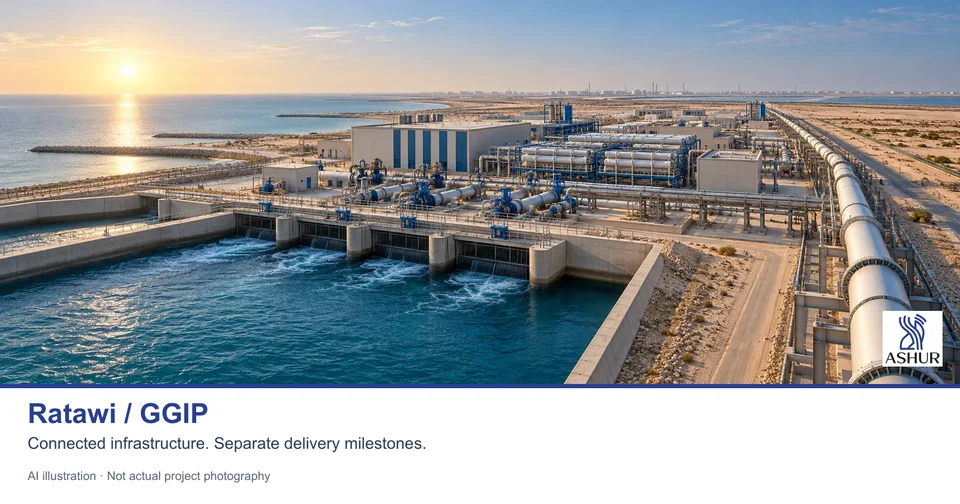
TotalEnergies describes GGIP as a coordinated programme covering Ratawi oil development, gas recovery, seawater supply and solar electricity in the Basra region. Its published umbrella participant interests are TotalEnergies 45%, Basrah Oil Company 30% and QatarEnergy 25%. Those figures should not be copied indiscriminately into every project-company or purchasing-party description.
The solar venture has a separate participation history: QatarEnergy's October 2024 announcement set out a 50:50 arrangement with TotalEnergies, subject to approvals. That announcement is not, by itself, evidence of subsequent transaction closing. Buyers and suppliers should establish the legal counterparty for the actual package instead of inferring it from the GGIP name.
Evidence: G-OVERVIEW G-QNA-20241028
On 29 October 2026, TotalEnergies' chief executive reported Ratawi production above 100 kboe/d and described a further phase-one milestone expected by November. This is a dated company statement, not a verified rate for 22 November. The transcript uses barrels of oil-equivalent; it should not be silently rewritten as crude-only barrels.
The published development plan separately describes 120,000 barrels per day for the initial oil-development phase and 210,000 barrels per day for full-field development. These are project capacities or objectives in their cited context. An intended November milestone is not automatically achieved merely because November has arrived.
Evidence: G-20261029 G-OVERVIEW
ArtawiGas25 was launched as an early-gas project with a design capacity of 50 million cubic feet per day. The October earnings call reports startup during that week. This advances the evidence beyond the January 2025 construction announcement and the older end-2025 expectations that remain on some project material.
The larger gas-midstream scheme is a separate development stream. TotalEnergies' September 2025 release described a 300-million-cubic-feet-per-day project entering construction. Its intended supply to electricity generation depends on gathering, treatment and delivery interfaces. Startup of the early unit does not demonstrate full main-plant capacity, verified continuous throughput or completion of every field connection.
Evidence: G-20250110 G-20261029 G-20250915
The common seawater supply project addresses injection-water needs. TotalEnergies announced the construction launch in September 2025 and identifies a first-phase target of five million barrels of water per day. This is water-system capacity, not oil production. It is also not interchangeable with figures quoted for other proposed Iraqi seawater projects.
Water intake and treatment, pumping, trunk lines and receiving-field interfaces form a connected delivery chain. For commercial planning, each requires an identifiable scope and acceptance boundary. No current delivered-water rate, finished-system acceptance or universally open supplier package was established in this review.
Evidence: G-OVERVIEW G-20250915
The Iraqi National Investment Commission's 13 November 2026 announcement says the investment licence was amended after financial close and reports that the first phase was complete. The official-domain announcement was retrievable through search, while direct page access returned HTTP 403. That access limitation is recorded; it is not a contradiction of the announcement.
The programme is described as 1 GW in alternating-current terms, while QatarEnergy's solar announcement uses 1.25 GW peak. These are different rating conventions, not competing observations of current electricity output. The latest announcement does not establish present dispatched MW, acceptance of all units or completion of the entire solar programme.
Evidence: G-NIC-20261113 G-20250915 G-QNA-20241028
ASHUR analysis: the most useful procurement questions sit at the boundaries between work packages. A material specification is incomplete without its receiving facility, inspection and handover requirements. A shipment plan is incomplete without a responsible importer and documented site-delivery interface. Commissioning support requires a defined energisation, testing or acceptance scope.
For a supplier, these observations justify preparation rather than a claim that business is available. Keep company registration, tax and workforce documentation current; maintain product traceability and manufacturer evidence relevant to the actual specification; and reconcile freight responsibilities with the eventual contract. No ASHUR appointment, access to non-public procurement, project engagement or guaranteed award is implied.
Prioritise the buyer's current qualification route and an authentic package document over social-media mobilisation claims. Equipment arriving at a site is a logistics event. A construction launch is an execution event. Neither proves commercial acceptance, continuous operation or a final payment milestone.
Update the dossier when a dated primary source establishes completed phase-one oil performance, stable gas delivery, commissioned seawater capacity or additional solar-unit acceptance. Keep announcement date, event date and observation period separate. If a new statement changes a target, retain the earlier target as history rather than silently rewriting it.
A fresh procurement notice would need its own issuer, scope, publication date, deadline and amendment history. This dossier does not expand the public tender feed, name bidders or infer awards. Financial close and investment licensing are important project milestones, but do not automatically establish every subcontract's status.
QatarEnergy announces proposed 50% solar participation; TotalEnergies retains 50% under announced terms.
Evidence state: Conditional participation announcement
Not established: Transaction closing from that announcement alone
ArtawiGas25 construction launched.
Evidence state: Construction launch
Not established: Commercial operation at that date
Full-field Ratawi and seawater construction launch reported; all four GGIP streams described as in execution.
Evidence state: Execution milestone
Not established: Completion of the whole programme
CEO reports Ratawi above 100 kboe/d and ArtawiGas25 startup that week; phase-one November target remains forward-looking.
Evidence state: Dated company operating statement
Not established: 22 November operating rate or full-field completion
NIC reports licence amendment after financial close and completion of first phase.
Evidence state: Government milestone report
Not established: Current dispatched MW or all-unit completion
ASHUR analytical schematic based on the cited project scope. Arrows show functional interfaces, not an engineered design, award chain or common commissioning date.
Capacity target ≠ current production
Early gas startup ≠ full gas-system completion
Water capacity ≠ crude-oil output
Phase completion ≠ full dispatched capacity
For relevant ASHUR advisory or procurement support, contact info@ashuriraq.com. No project appointment or confidential access is implied.